

Proteins
Recombinant Mature Human TGF-beta1 (rhTGF- β1)
- Cat.2001
- SpeciesHuman
- SourceHEK 293 cells
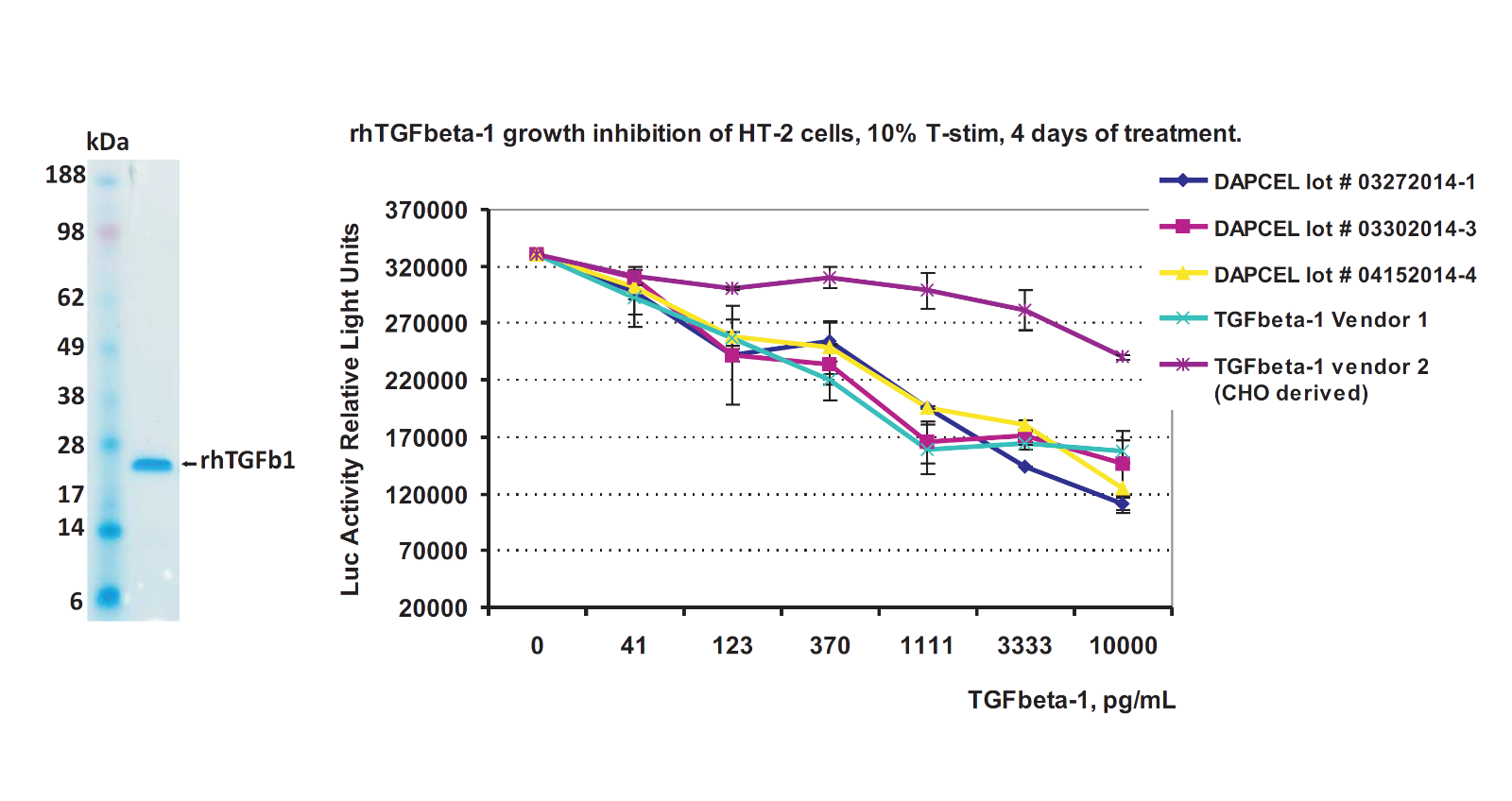
SDS-PAGE of rhTGF-β1 (left) and growth inhibition of HT-2 cells by three DAPCEL rhTGF-β1 lots and two other vendors’ TGF-β1 (right), from the product datasheet. Lot-specific values are provided on the COA.
Product details
Mature human Transforming Growth Factor beta-1, HEK 293-expressed under serum-free / animal-free conditions and activity-tested in an HT-2 growth-inhibition assay — for TGF-β signaling, proliferation and differentiation research.
| Catalog Numbers: | 2001-1 (1 µg), 2001-2 (2 µg), 2001-5 (5 µg), 2001-10 (10 µg) |
|---|---|
| Species: | Human |
| Source: | HEK 293 cells |
| Production: | Serum-free / animal-free media |
| Amino acids: | 279–390 (mature TGF-β1) |
| Predicted molecular weight: | 12.79 kDa (monomer) |
| SDS-PAGE molecular weight: | 14 kDa (reducing) / 25 kDa (non-reducing) |
| Protein ID: | P01137 (TGFB1_HUMAN) |
| Purity: | >97% by SDS-PAGE (SimplyBlue SafeStain) |
| Functional activity: | Tested in an HT-2 cell growth-inhibition assay |
| Endotoxin: | <1 EU/µg (LAL method) |
| Formulation: | Dried from a 0.2 µm filtered solution of 20 mM citric acid |
| Reconstitution: | Spin before opening; reconstitute in sterile water at ~0.1 mg/mL. Do not vortex. |
| Storage & stability: | 12 months at −20 to −80 °C (dried); 6 months frozen or 1 month at 2–8 °C after reconstitution. |
| Intended use: | For research use only. Not for use in diagnostic or therapeutic procedures. |
Purity & activity
Purified to >97% and activity-tested in an HT-2 cell growth-inhibition assay.
Scientific background
Transforming growth factor beta-1 (TGF-β1) is a member of the TGFB cytokine family. It is processed from a 390-amino-acid pre-pro polypeptide and secreted into the extracellular matrix as an inactive complex with its latency-associated peptide (LAP) and latent TGF-β1 binding protein-1; dissociation from LAP is required for biological activity.
TGF-β1 controls cellular proliferation and differentiation. It has been implicated in the immune response and in cancer, cardiovascular disease, diabetes, Marfan and Loeys–Dietz syndromes, and other conditions.
Publications using DAPCEL technology and products are listed on the publications page.
Published studies that used this product
All publications- Pericentromeric satellite lncRNAs are induced in cancer-associated fibroblasts and regulate their functions in lung tumorigenesisCell Death & Disease (2023)
- Oncostatin M promotes cancer cell plasticity through cooperative STAT3-SMAD3 signalingOncogene (2017)
- p38MAPK builds a hyaluronan cancer niche to drive lung tumorigenesisGenes & Development (2016)
More proteins
See all

