

Proteins
Recombinant Human Haptoglobin-Zonulin
- Cat.6001
- SpeciesHuman
- SourceHEK 293 cells
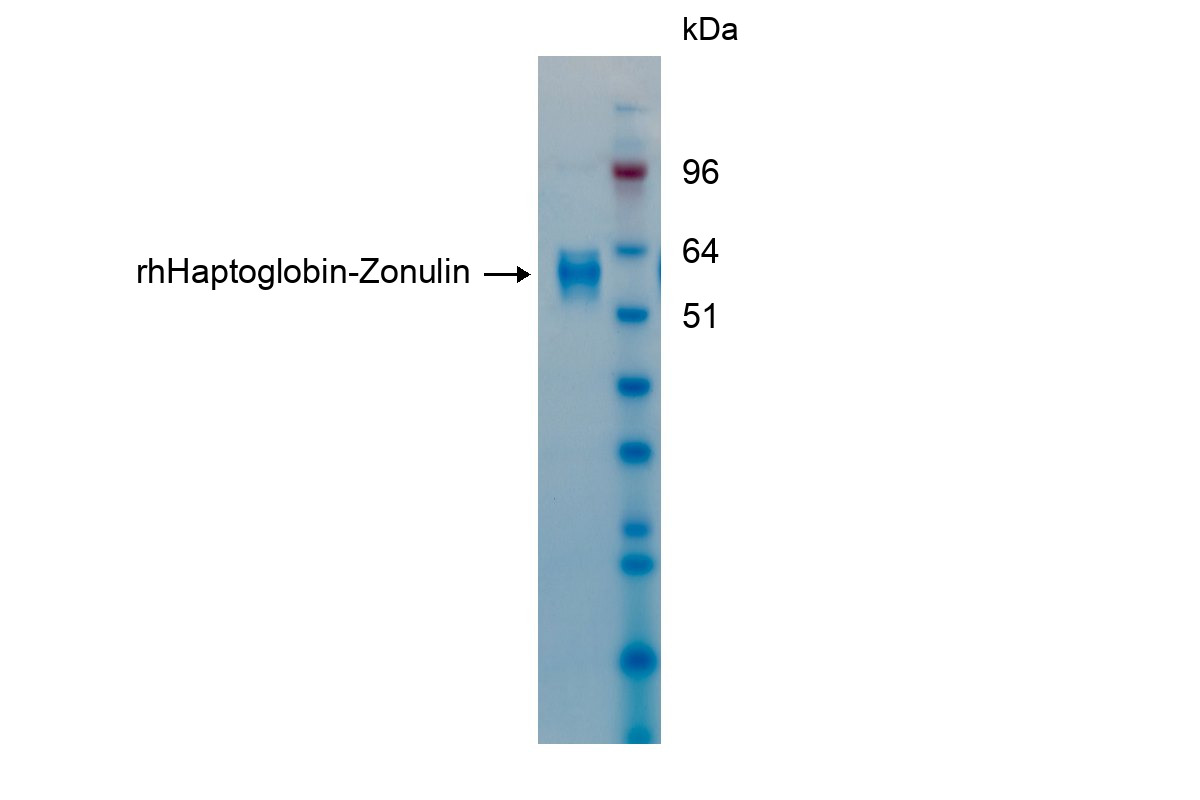
SDS-PAGE of recombinant human Haptoglobin–Zonulin (~55 kDa), from the product datasheet. Lot-specific values are provided on the COA.
Product details
Recombinant human Haptoglobin–Zonulin, HEK 293-expressed under serum-free / animal-free conditions — a physiological modulator of epithelial and endothelial tight-junction permeability, for intestinal-barrier, blood–brain-barrier and inflammation research.
| Catalog Numbers: | 6001-50-CF (50 µg), 6001-1000-CF (1 mg), 6001-5000-CF (5 mg) |
|---|---|
| Species: | Human |
| Source: | HEK 293 cells |
| Production: | Serum-free / animal-free media |
| Amino acids: | 19–406 (Arg161→Gly161) |
| Predicted molecular weight: | 43.2 kDa |
| SDS-PAGE molecular weight: | ~55 kDa (reducing conditions) |
| Protein ID: | HPT_HUMAN |
| Purity: | >95% by SDS-PAGE (SimplyBlue SafeStain) |
| Endotoxin: | <0.1 EU/µg (LAL method) |
| Formulation: | Lyophilized from a 0.2 µm filtered solution of PBS, pH 7.4 |
| Reconstitution: | Spin before opening; reconstitute in sterile water at ~0.1 mg/mL. Do not vortex; allow 10–15 min gentle agitation before use. |
| Storage & stability: | 12 months at −20 to −80 °C (dried); 6 months frozen or 1 month at 2–8 °C after reconstitution. |
| Intended use: | For research use only. Not for use in diagnostic or therapeutic procedures. |
Identity & purity
Purified to >95%, resolving at ~55 kDa by SDS-PAGE under reducing conditions.
Scientific background
Zonulin is a physiological regulator of epithelial and endothelial tight junctions and is closely related to the haptoglobin family. It modulates paracellular permeability by triggering signaling that leads to tight-junction disassembly and cytoskeletal rearrangement.
Dysregulation of zonulin signaling has been implicated in disorders of impaired barrier integrity, including gastrointestinal inflammatory diseases and neuroinflammatory conditions. This recombinant is suitable for intestinal-permeability, blood–brain-barrier, inflammation and host-immune-response studies.
Reference: Rahman MT, Ghosh C, Hossain M, et al. (2018). “IFN-γ, IL-17A, or zonulin rapidly increase the permeability of the blood-brain and small intestinal epithelial barriers: relevance for neuro-inflammatory diseases.” Biochem Biophys Res Commun 507(1–4), 274–279. doi:10.1016/j.bbrc.2018.11.021 ↗
Publications using DAPCEL technology and products are listed on the publications page.
Published studies that used this product
All publications- IFN-γ, IL-17A, or zonulin rapidly increase the permeability of the blood-brain and small intestinal epithelial barriers: Relevance for neuro-inflammatory diseasesBiochemical and Biophysical Research Communications (2018)
More proteins
See all

